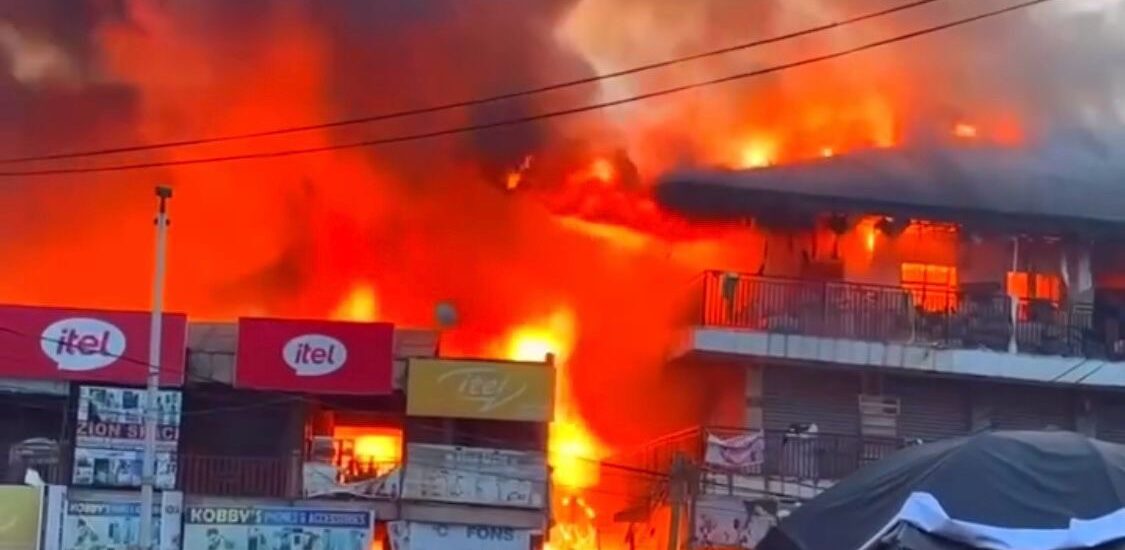
In the early hours of 21st March 2025, Ghanaians woke up to yet another devastating
fire outbreak, this time in Adum, the bustling commercial heart of Kumasi, the capital of
the Ashanti Region and Ghana’s second-largest city. The blaze, which ripped through
sections of this vital trading hub, sent thick plumes of toxic black smoke into the skies
and could be seen from miles away. As traders looked on helplessly, years of savings,
goods, and capital were reduced to ashes. This incident follows closely on the heels of
a similar disaster in Katamanto, a busy market area in Greater Accra, where fire gutted
numerous shops, wiping out the livelihoods of many small-scale traders.
The cause of the Kumasi fire remains under investigation, with officials from the Ghana
National Fire Service (GNFS) expected to release a formal report in the coming days.
However, preliminary reports suggest that poor electrical wiring, congested structures,
and lack of fire safety mechanisms may have played a role, challenges that have been
highlighted in numerous past reports but remain inadequately addressed.
Coincidentally, on the same day, a massive fire broke out at an electrical substation
near Heathrow Airport in London, one of the world’s busiest aviation hubs. The fire led
to the temporary shutdown of the airport, the cancellation of thousands of flights, and
mass disruptions across the UK and Western Europe. British authorities immediately
deployed high-tech fire engines and rapid response teams, containing the fire within
hours. Detailed economic assessments are already underway to quantify the losses and
plan compensation.
In contrast, Ghana’s response to such emergencies often lacks precision, adequate
resources, and long-term planning. More often than not, we fail to capture the economic
losses these fires inflict on our informal sector, an area that contributes approximately
70% to Ghana’s employment and plays a significant role in the country’s GDP. The
absence of data-driven damage assessments and lack of insurance coverage for
affected traders only compounds the economic devastation.
Lessons from the Great Fire of London and Other Global Incidents:
After the Great Fire of London in 1666, authorities instituted far-reaching reforms,
including strict building codes, fire-resistant materials, wide roads for fire truck access,
and mandatory fire hydrants in commercial areas. These measures transformed urban
planning and significantly reduced the frequency and impact of major fires in the UK.
It’s time Ghana followed suit.
Recommendations for Ghana’s Fire Safety Reform
A Call for Resilience in a 24-Hour Economy
As Ghana seeks to industrialize and introduce a 24-hour economy, the ability to
safeguard commercial infrastructure becomes non-negotiable. Investors, both local and
foreign, need assurance that their assets are protected—not only from theft or political
instability but from the increasingly common threat of fire disasters.
If we are to build a resilient economy that can withstand shocks and protect livelihoods,
then we must act decisively and differently. The infernos in Accra and Kumasi are not
just isolated incidents, they are warnings. Let us not wait for another tragedy to make
the necessary changes.
Food for thought from a concerned Ghanaian citizen.
Fiifi Asante Mparey
NDC UK and Ireland Chapter, Deputy Communications Officer